Nature Communications · 2026
Photorealistic 3D Holographic Display with Natural Defocus Effect
Bringing natural focus and defocus to holographic displays through neural rendering and physically constrained wavefront generation.
Video demonstration
Reference comparisons and optical reconstruction sequences as focus changes across the scene. Silent video.
01 / The idea
Natural blur.
Consistent depth.
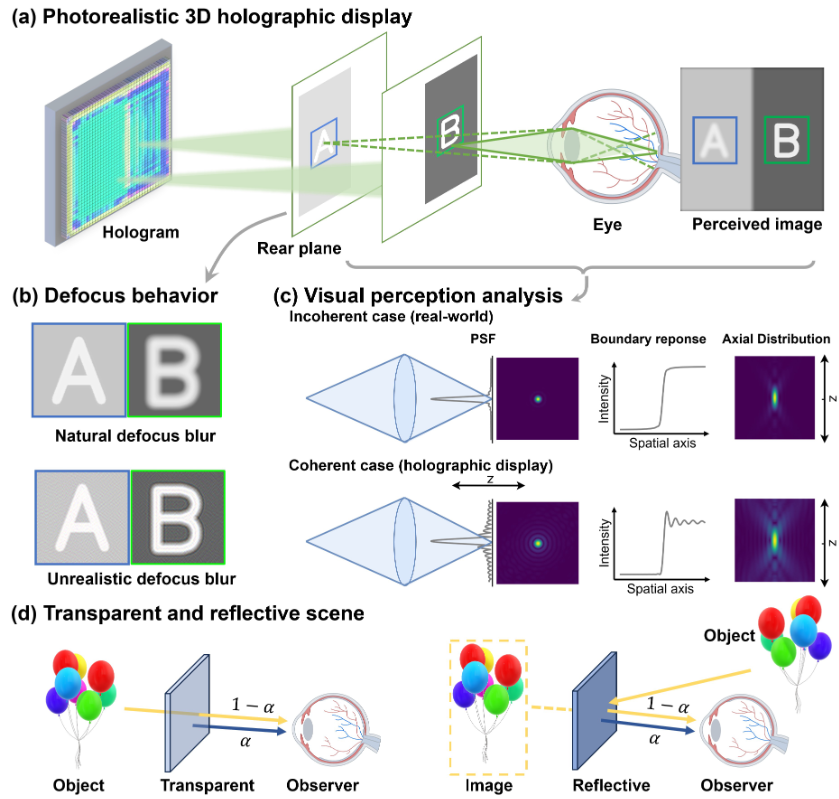
Sharp objects are only part of a convincing 3D image. Out-of-focus regions also need to behave naturally. Conventional coherent holographic models can introduce ringing and incorrect depth cues, especially around transparent or reflective surfaces.
Our framework combines layered RGB-D scene information, neural rendering, and phase prediction with explicit wave-optical propagation. It preserves multiple depth contributions and generates a physically consistent wavefront for phase-only holographic display.
Based on the published paper.
02 / The method
Rendering meets
wave optics.
Represent the scene
Layered RGB-D retains depth information behind transparent surfaces and within reflections.
Infer the wavefront
Neural rendering supplies amplitude information; phase prediction completes the complex field.
Enforce propagation
Explicit diffraction and phase-only encoding connect the inferred field to the display.
From simulation to experiment
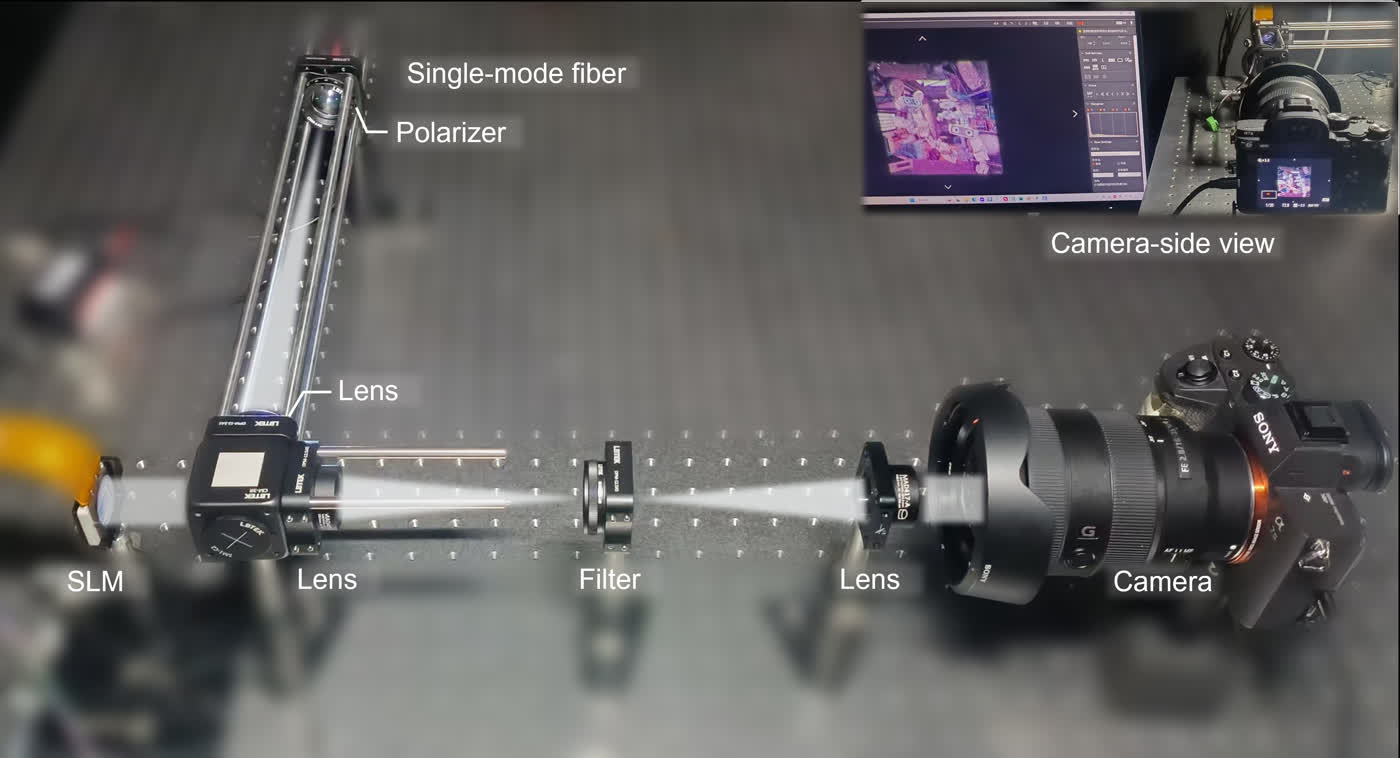
The same Couch scene is shown as a reference focal sweep, a numerical reconstruction, and an optical capture. Each clip can be played independently.
Reference
Simulation
Experiment
Citation
@article{zhou2026naturaldefocus,
  title = {Photorealistic 3D Holographic Display with Natural Defocus Effect},
  author = {Zhou, Mi and Chen, Mu Ku and Liu, Fei and Shen, Mei and Lei, Lei and Ma, Chaoqun and Wang, Xueqian and Song, Jian and Wang, Haoqian and Dong, Kaichen and Zuo, Chao and Geng, Zihan},
  journal = {Nature Communications},
  volume = {17},
  pages = {6117},
  year = {2026},
  doi = {10.1038/s41467-026-72736-7},
  url = {https://doi.org/10.1038/s41467-026-72736-7}
}
Publication details: Nature Communications 17, 6117 (2026). Demonstration media supplied by the authors. Couch scene attribution is documented in the paper.